From Research to Practice
While the research established a framework for understanding artificial intelligence as a cultural object, translating this inquiry into practice posed immediate challenges. Early attempts focused on visualising policy frameworks directly, with the aim of exposing contradictions within regulatory language. However, this approach quickly revealed its limits. Policy documents are, by design, abstract and open to interpretation. Rendering them visually risked reproducing the same ambiguity without meaningfully shifting it.
At the same time, I became cautious of practices that foreground artificial intelligence as spectacle. Many works engaging with AI centre on technical capability, reducing critique to novelty or demonstration. This felt misaligned with the questions driving my research, which were less concerned with what AI can do and more with how it becomes legible, trustworthy, and culturally authoritative.
This tension prompted a shift away from explanatory design. Rather than clarifying AI systems, I began focusing on the conditions through which understanding is produced. Speculative design became useful not as a means of imagining distant futures, but as a way of slightly displacing the present. By situating the work in a plausible near future, existing patterns could be amplified just enough to become visible.
The decision to work within a journalistic context emerged from this shift. Journalism sits between policy, technology, and the public, translating complex systems into accessible narratives under pressure. As AI coverage proliferates, the rhythms of reporting and summarising become central to how trust is constructed. The journalist’s desk became a material site through which these processes could be examined.
Fictional elements were designed to feel continuous with real media artefacts, emphasising familiarity over rupture. The intention was not to deceive, but to create a space where the boundaries between policy, reporting, and speculation remain unstable. The work resists resolution, holding open the uncertainty that public-facing AI discourse often smooths over.
Rather than presenting a singular argument, the installation evolved as an environment shaped by accumulation. Meaning forms through proximity, repetition, and contradiction, mirroring the way technological narratives are encountered in everyday life.
World-Building the Installation
The world of Data, Bias, and Discourse is situated in an undefined near future. This temporal choice is not about prediction, but proximity. By placing the work just ahead of the present, existing patterns can be encountered with slightly altered clarity rather than speculative distance. The project operates within a familiar but unsettled present, where policy decisions, media narratives, and emerging technologies overlap without clear resolution.
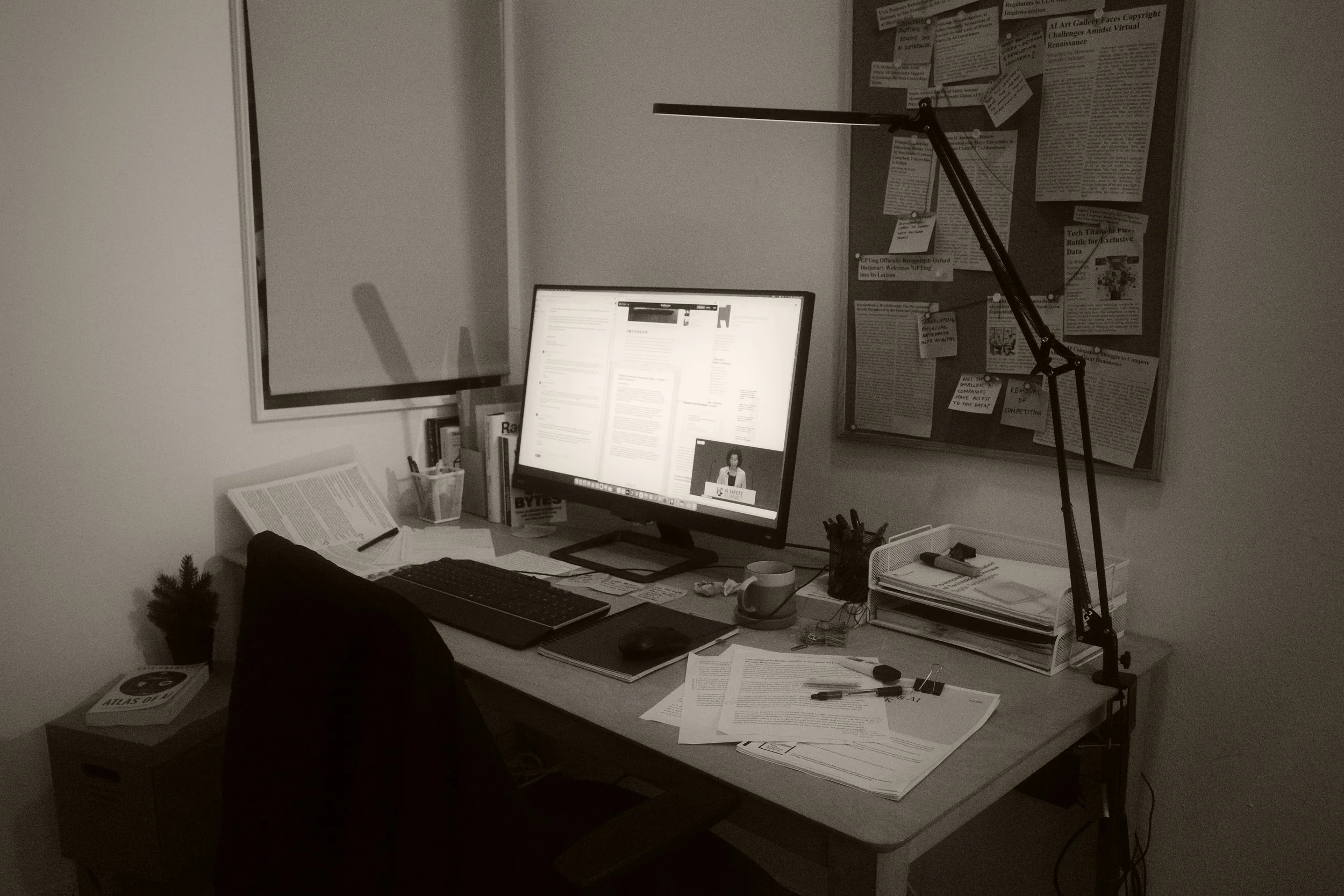
The installation is organised around a journalist’s desk. Journalism routinely translates complex systems into accessible narratives under conditions of urgency and repetition. As artificial intelligence becomes an increasingly dominant topic, reporting itself becomes part of how technological authority is produced and sustained.
The desk functions as a working surface shaped by accumulation. Documents are partially written, revised, annotated, or abandoned. Emails remain unresolved. Media artefacts coexist without hierarchy. Knowledge appears provisional and continually in progress.
Fiction and realism are deliberately entangled throughout the installation. Fabricated artefacts are designed to be indistinguishable from plausible policy documents, news stories, or internal communications. This approach is not intended to deceive, but to create uncertainty around what is official and what is speculative. In doing so, the work reflects how authority is often established through familiarity and form rather than verification.
There is no prescribed path through the work. Visitors encounter fragments out of sequence, allowing meaning to form through comparison rather than explanation. By slightly amplifying existing discursive patterns, the installation makes visible how artificial intelligence is framed and stabilised within everyday cultural life.
Components and Interactions
The installation is composed of material and digital artefacts distributed across the desk and its surroundings. Together, these elements stage the different discursive modes through which artificial intelligence is narrated, governed, and legitimised.
Broadcast Authority and Policy Spectacle
At the centre is a speculative recreation of an AI Safety Summit. Closely modelled on existing global policy events, the video adopts the staging, tone, and language of institutional authority. Although fabricated, it mirrors the aesthetics of official broadcasts, highlighting how credibility is produced through performance and repetition.
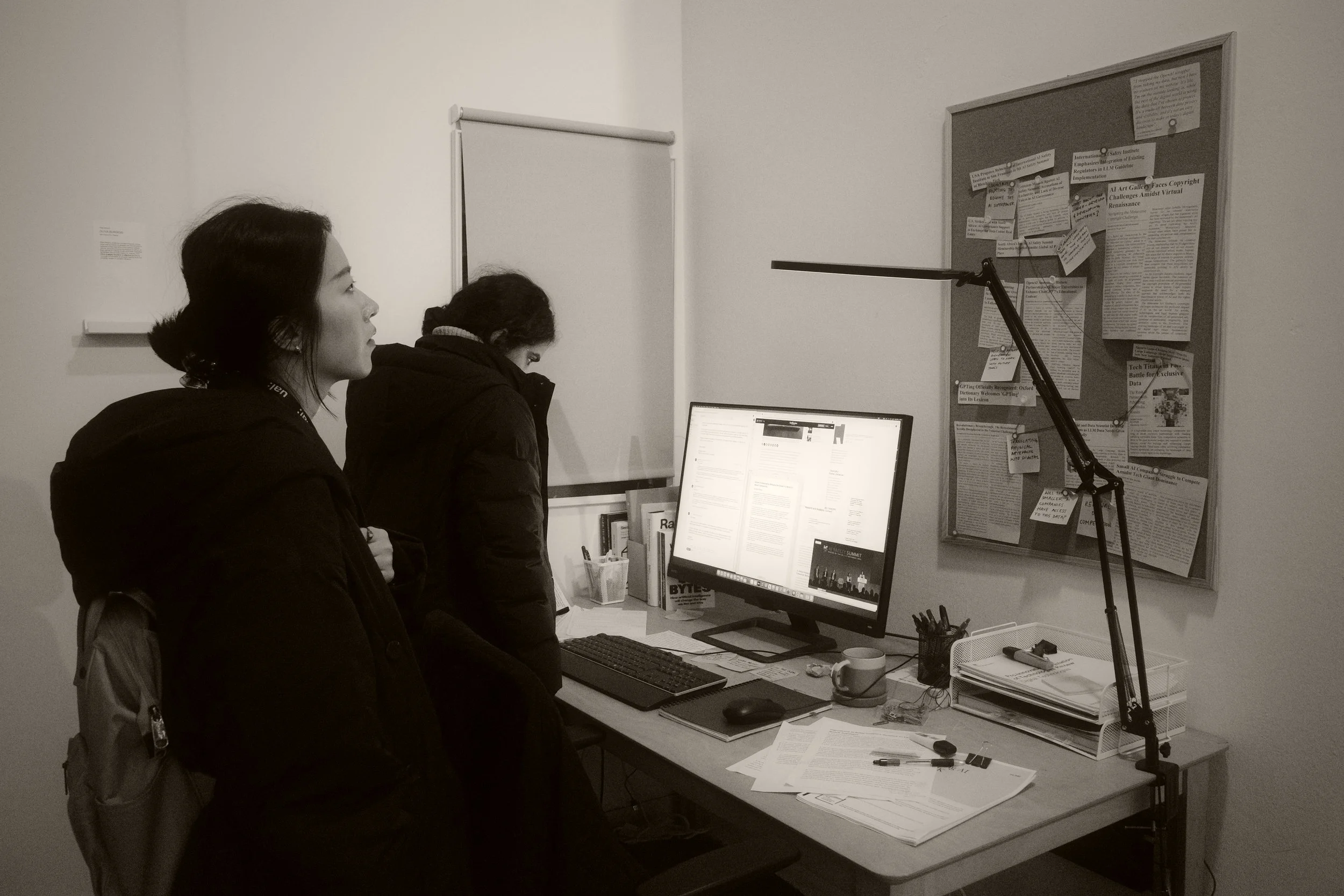
Some initially assumed the AI Safety Summit video to be real before questioning its status. Others struggled to distinguish fabricated documents from authentic ones. These moments revealed how credibility is granted through familiarity and tone.
Reflection tended to emerge over time. Short encounters reinforced coherence, while longer engagement exposed gaps and tensions. The work positions viewers as readers within a broader informational landscape, inviting attention to the conditions through which trust and authority take shape.
Reflection and Open Questions
Data, Bias, and Discourse began as an attempt to remain with uncertainty rather than resolve it. Throughout the making process, it became clear that questions surrounding AI, regulation, and bias resist straightforward answers, particularly when shaped by systems that prioritise reassurance and forward momentum.
Working with the visual language of journalism and policy was deliberate, but uneasy. These formats carry authority because they are familiar. Engaging them closely risked reinforcing the structures the work examines. That tension remains unresolved and is part of the project itself.
The process underscored how difficult it is to locate responsibility within contemporary technological systems. Governance unfolds through drafts, partnerships, coverage, and delay. Bias appears less as technical failure and more as an outcome of repeated framing and omission.
These questions extend beyond AI. They speak to how knowledge is produced and trusted, and how authority operates through infrastructures that present themselves as neutral.
Rather than offering closure, the work remains open. It suggests that sustained attention and partial understanding may be necessary when engaging with systems that resist simplification.
Journalistic Narratives and Media Repetition
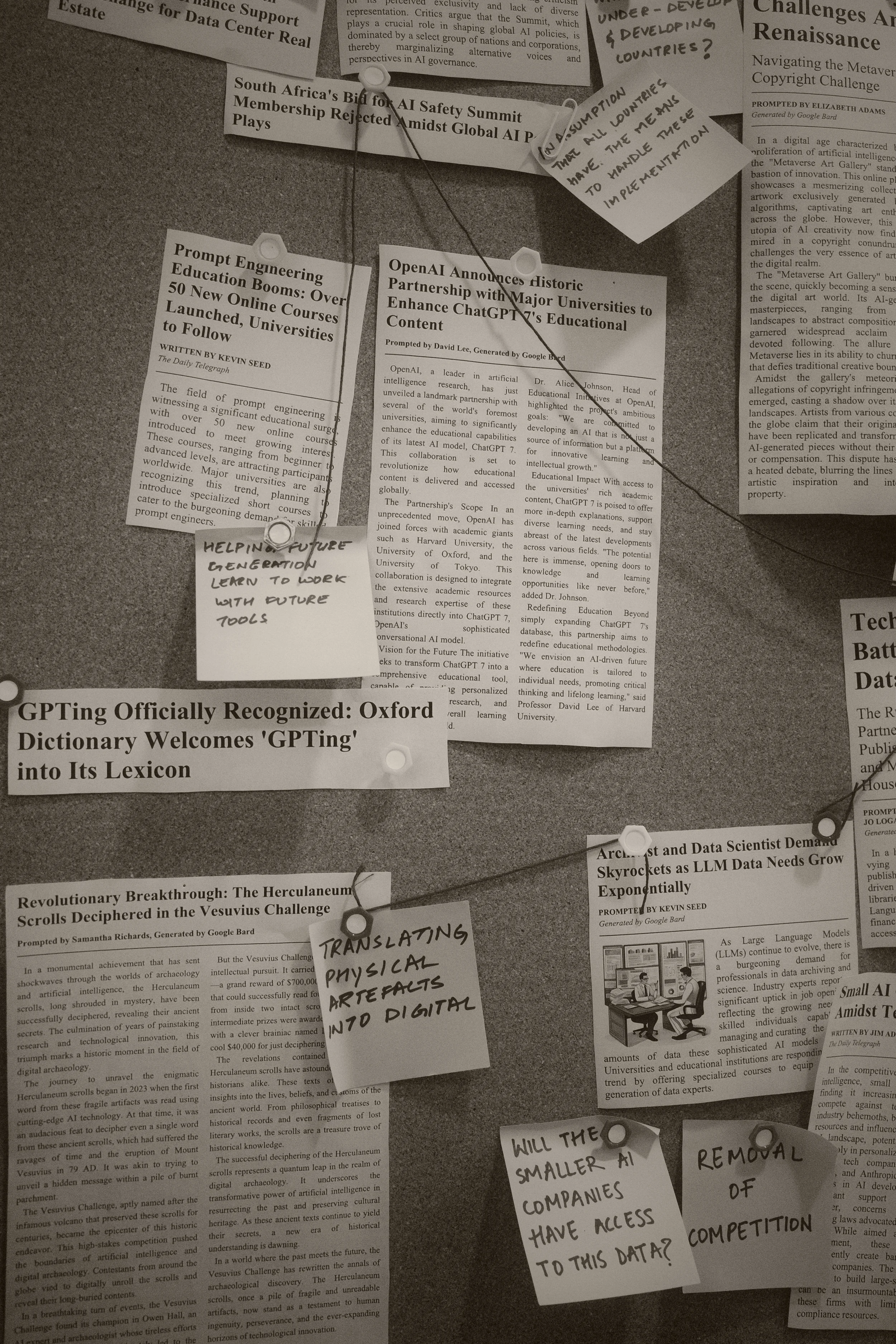
Surrounding the broadcast are news articles reflecting contemporary AI coverage. They present narratives of progress, opportunity, and governance, from university partnerships and AI education programmes to the expansion of data infrastructure. Across headlines, similar claims recur, reinforcing AI as inevitable and beneficial.
Moments of critique appear but remain contained. Coverage of summit exclusivity, geopolitical tensions, and data ownership sits alongside optimistic narratives, rarely disrupting the broader tone of stability.
Audience Engagement and Response
Engagement unfolded slowly. Many visitors initially looked for a clear narrative. Instead, they had to decide how to read the work.
Visitors often remained at the desk for extended periods, moving between fragments and revisiting materials. Understanding accumulated gradually through repetition and comparison.
Institutional Documentation and Procedural Negotiation
The installation also includes fabricated webpages, internal emails, and a speculative guideline for large language models. These artefacts mimic the language and structure of institutional documentation. The guideline outlines principles of ethical development and responsibility, echoing contemporary policy discourse while blurring distinctions between aspiration and enforcement.
Email exchanges reveal governance as negotiation rather than declaration. Proposals remain unfinished, responsibilities deferred. Authority appears distributed across documents and institutions rather than located in a single source.
Accumulation, Comparison, and Reading
Interaction is non-directive. Visitors move between summit rhetoric, journalistic coverage, and institutional documentation without instruction. Authority emerges relationally, through alignment across formats. Responsibility remains diffuse.